Ayaan Jindal
June 15, 2026 · 4 min read
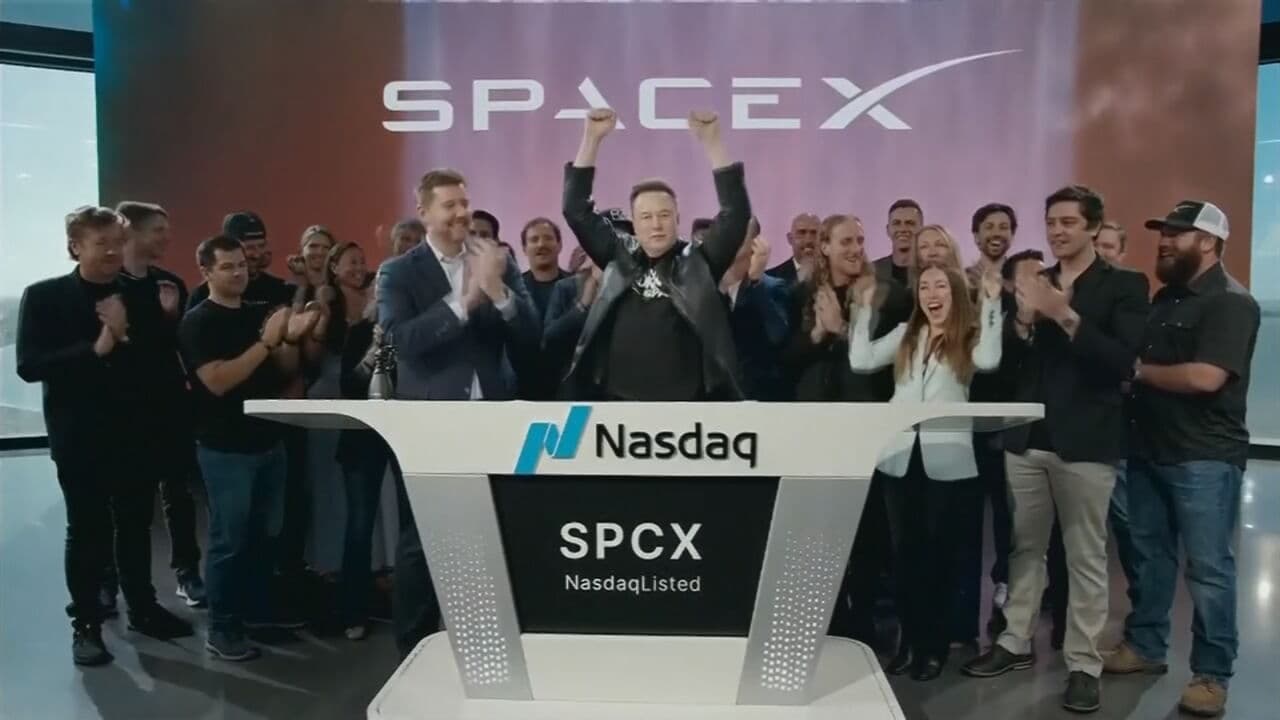
On Friday, June 12th, SpaceX went public on the Nasdaq under the ticker SPCX. It was a historic event. The company sold more than 555 million shares at $135, bringing in roughly $75 billion, by far the biggest IPO in history. On the company's first day of trading, as predicted, it shot up, closing at $160.95, up 19%, and valuing Elon Musk's rocket company at some $2.1 trillion. This would make the rocket-launching company the 6th most valuable publicly traded company in the U.S., behind Nvidia, Apple, Microsoft, Alphabet (Google), and Amazon, and only just ahead of Tesla (for now, this is subject to daily fluctuation).
A new milestone in the history of capital markets, a historic moment for the new shareholders of SpaceX, and a multi-billion dollar question for the institutional investors and analysts sizing it up. Are they worth it?
What You Are Actually Buying
The biggest part of the value at SpaceX today is in its satellite internet business, Starlink. It has over 9,800 satellites in orbit, and more than 10 million users in 100 countries around the world. Launches of rockets are the sexy part of the business. But the money is in the recurring revenue from Starlink. That's the kind of business that can command a high multiple, and that's why the valuation of SpaceX is so high.
SpaceX, in addition to the launch services provided to satellite manufacturers, also provides satellite services through its Starlink satellite constellation. It also recently acquired xAI, an advanced AI company founded by Musk in 2023, which will enable the development of advanced AI systems on board SpaceX's Starlink satellites. So, for investors purchasing a share of SPCX on the first day of trading, they are actually purchasing the shares of three different companies, the launch services company, the Starlink satellite internet services provider, and an AI company.
The Valuation Gap
For now, SpaceX's revenue is relatively modest. For 2025, Starlink raked in an estimated $4.1 billion in revenue, and AI company xAI brought in around $3.2 billion. With a $1.77 trillion listing price, that means investors are not paying for what the company earns today. The valuation implies that investors expect substantial growth over many years and are willing to pay for that future potential now.
There is a huge spread between what Morningstar believes SpaceX is worth and what it is trading at. Morningstar estimates fair value at roughly $780 billion, less than half its $1.77 trillion IPO valuation. That gap, close to $1 trillion between the price the market set and the value one of the most careful analysts on Wall Street assigns to the company, is the trillion-dollar question. Either the market sees something the skeptics do not, or this is another case of investors paying for a compelling story rather than focusing on the hard numbers.
Musk Keeps the Keys
One more fact to consider here is that Musk retains control of the company. After SpaceX went public and issued tens of billions of dollars of stock, Musk still owns 42% of the total shares issued. However, he retains control because his special stock carries 82% of the voting power. That's because his shares are designated as Class B shares with 10 votes per share, as opposed to the Class A stock issued to the public, which carries one vote per share. Of course, this dual-class structure is nothing new in the corporate world, and is used by Google, Meta, and a host of other publicly traded technology companies to maintain control by their founders. But it's worth noting.
But it is an important consideration for investors in SPCX. For all the money they're paying for a share of the company's profits, they have virtually no say in how the company is run. That's all up to Musk.
Why So Much Went to Regular Investors
SpaceX's IPO included an unusual feature for a tech IPO: a large percentage of the shares were set aside for retail investors. More than 30% of the total number of shares issued in the IPO were reserved for the public at large, rather than large institutional investors. And retail investors lapped up the opportunity to buy in, as did many institutional investors. In the end, more than 500 million shares of SpaceX changed hands on the first day of trading on the Nasdaq, the second-largest IPO-day volume in the stock exchange's history, behind only Facebook in 2012.
This pattern of strong first-day demand is not necessarily indicative of a fair price for an IPO. Facebook itself fell sharply in the months after its 2012 debut before eventually recovering.
The Bottom Line
The SpaceX IPO is a historical event, the largest IPO the world has seen so far. It's understandable that everyone is excited with it, because SpaceX has a very important business, the Starlink satellite internet business with more than 9,800 satellites in orbit right now, and 10 million+ customers in 100+ countries. It is a global internet service. But a $1.77 trillion valuation for a few billion in revenue only makes sense if the IPO price is the starting point for how much the public believes the company will earn a decade from now. Morningstar recently estimated fair value at roughly $780 billion, less than half of Friday's closing price. So, investors in the IPO are betting on the future for SpaceX, and paying a very large premium to the current earning power of the business.
%3Amax_bytes(150000)%3Astrip_icc()%2FGettyImages-1195603075-7e8dc700af47458e9b4f03a91c1397d8.jpg&w=3840&q=75)
Discussion
Comments
Loading…
Leave a comment
Be the first to share your thoughts.